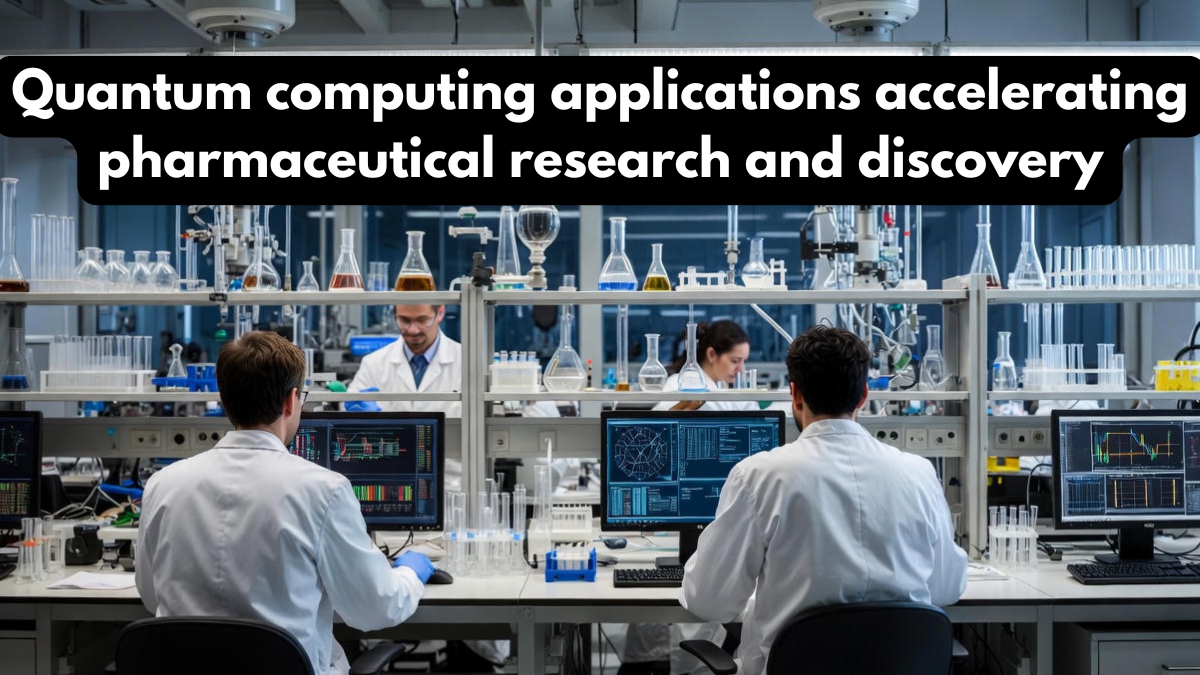
The transformative potential of quantum computing is beginning to reshape one of the world’s most research-intensive industries: pharmaceuticals. For decades, drug development has been a lengthy, expensive, and complex process requiring extensive laboratory testing, computational modeling, and years of clinical validation. Today, the emergence of quantum technologies offers an unprecedented opportunity to accelerate this work by solving molecular simulations that classical computers struggle to process. These advancements are positioning quantum systems as powerful tools for drug discovery, enabling researchers to understand biological mechanisms with far greater precision and speed.
As global demand for faster and more effective medications continues to rise, pharmaceutical companies are investing heavily in emerging technologies. This shift aligns with broader trends in pharma innovation, where digital transformation, automation, and advanced computing redefine how treatments are designed. Quantum computing can simulate molecular interactions at the quantum level, offering deeper insights into chemical properties and potential drug candidates. These capabilities hold promise for reducing development timelines, lowering costs, and unlocking therapies for diseases that currently lack effective treatments.
This article explores how quantum computing is revolutionizing pharmaceutical research, the scientific principles behind these advances, and the challenges that must be overcome for widespread adoption. With quantum technologies evolving rapidly, the future of medicine may soon depend on the integration of quantum-enhanced tools.
How Quantum Computing Supports Molecular Simulation
At the core of drug discovery lies the need to understand how molecules behave. Classical computers struggle with this task because molecular interactions follow the rules of quantum mechanics, which require vast computational power to simulate accurately. The complexity increases exponentially as molecules grow larger, making traditional simulation methods slow and imprecise.
Quantum computers, however, operate using qubits, which can exist in multiple states simultaneously. This property—known as superposition—allows quantum systems to analyze highly complex molecular structures far more efficiently. Entanglement, another central principle of quantum mechanics, enables qubits to work together in ways that dramatically enhance computational capabilities. These features make quantum systems uniquely suited for modeling interactions critical to pharma innovation, such as protein folding, molecular binding affinity, and reaction pathways.
As researchers gain access to more powerful quantum machines, they can explore molecules previously considered too complex for computational study. This breakthrough opens new possibilities for identifying drug candidates and understanding disease mechanisms at unprecedented depths.
Key Quantum Applications in Pharmaceutical Research
The integration of quantum computing into pharmaceutical workflows has sparked new collaborations among technology companies, research institutions, and drug manufacturers. Several promising applications are emerging, each contributing to more efficient and accurate drug discovery processes.
Below is a table highlighting major quantum applications and their potential impact on pharma innovation:
| Quantum Application | Description | Impact on Pharma Innovation |
|---|---|---|
| Molecular Simulation | Models molecular interactions at the quantum level | Accelerates the identification of viable drug candidates |
| Optimization Algorithms | Enhances drug formulation and dosage optimization | Improves treatment precision and reduces development errors |
| Quantum Machine Learning | Analyzes large biochemical datasets | Discovers hidden patterns and accelerates biomarker research |
| Protein Folding Prediction | Maps complex protein structures | Supports therapies for diseases linked to protein misfolding |
| Reaction Pathway Modeling | Predicts chemical reactions | Reduces laboratory experimentation time and cost |
These applications illustrate how quantum tools strengthen pharmaceutical research at every stage—from early target identification to late-stage formulation refinement. As quantum hardware improves, these capabilities will expand, supporting more advanced therapeutic development.
Advantages of Quantum Computing in Drug Discovery
The most significant advantage of quantum computing is its potential to reduce drug development timelines. Traditional discovery processes often span over a decade, costing billions of dollars and involving extensive trial-and-error experimentation. With quantum-enhanced simulation, researchers can quickly test thousands of molecular combinations, identify promising candidates, and eliminate ineffective ones early in the pipeline. This precision accelerates early-stage drug discovery and reduces overall costs.
Quantum tools also enhance accuracy. By simulating real-world molecular interactions rather than approximations, quantum systems provide insights grounded in true quantum behavior. This leads to better predictions of drug efficacy, safety, and side effects. Such advancements are critical for pharma innovation, which depends on accurate models to ensure patient safety and regulatory compliance.
Furthermore, quantum computing enables research into complex diseases previously considered too challenging for computational modeling. Conditions influenced by intricate molecular processes—such as Alzheimer’s, Parkinson’s, and certain rare genetic disorders—may become more treatable as quantum models improve understanding of disease-specific interactions.
Challenges in Implementing Quantum Technologies
Despite the promise of quantum computing, several challenges must be addressed before it becomes a mainstream tool in pharmaceutical development. Current quantum hardware is still in the early stages of maturity. Systems often experience noise, instability, and limited qubit capacity, restricting their ability to handle extremely large simulations.
Developing quantum algorithms suitable for drug discovery also requires specialized expertise. Many pharmaceutical teams lack personnel trained in quantum science, creating a knowledge gap that must be filled through education and cross-industry collaboration.
Regulatory and ethical considerations represent additional complexities. As quantum models gain influence, health regulators must establish guidelines to ensure the accuracy and reliability of quantum-derived insights. This will be essential for maintaining public trust and supporting safe pharma innovation.
Infrastructure requirements pose further limitations. Integrating quantum systems with existing digital tools requires powerful cloud platforms, advanced cybersecurity measures, and substantial investment costs. Until these logistical challenges are addressed, widespread adoption may progress gradually.
The Future of Quantum-Enabled Pharma Innovation
Looking ahead, advancements in quantum computing are expected to drive a new era of scientific discovery. As hardware becomes more stable and algorithms more refined, quantum systems will support deeper insights into molecular biology, genetic interactions, and personalized medicine. The ability to simulate individual patient responses to drugs, for example, may soon become a reality, transforming both drug discovery and treatment design.
Quantum collaboration networks are already forming globally, uniting pharmaceutical companies, universities, and technology firms to accelerate research. These partnerships aim to scale quantum innovations across multiple therapeutic areas, fostering a competitive yet collaborative landscape for pharma innovation.
The continued evolution of quantum technologies promises to reduce global health burdens, accelerate cures, and strengthen the resilience of healthcare systems. By embracing quantum tools, the pharmaceutical industry stands poised for unprecedented progress—unlocking therapies that were once unimaginable.
Conclusion
Quantum computing is rapidly emerging as a cornerstone of next-generation pharmaceutical research. By enabling accurate molecular simulations, optimizing complex drug formulations, and accelerating early discovery pipelines, quantum technologies offer tremendous potential for global health advancement. The integration of quantum methods with traditional computational and laboratory techniques will redefine drug discovery strategies and fuel widespread pharma innovation. While challenges remain, the future of medicine is increasingly tied to quantum-enabled breakthroughs that promise faster, safer, and more effective healthcare solutions.
FAQ
How does quantum computing improve drug discovery?
It accelerates molecular simulations, identifies drug candidates faster, and enhances prediction accuracy.
Why is quantum computing important for pharma innovation?
It enables new research capabilities, reduces development costs, and improves treatment precision.
What diseases could benefit from quantum research?
Neurological disorders, rare diseases, cancers, and conditions with complex molecular behaviors may see major breakthroughs.
Are quantum computers widely used in pharma today?
Not yet, but early partnerships and pilot projects are rapidly expanding adoption.
What challenges limit quantum adoption in drug development?
Hardware limitations, skill shortages, regulatory uncertainty, and high infrastructure costs remain major barriers.
Click here to learn more